



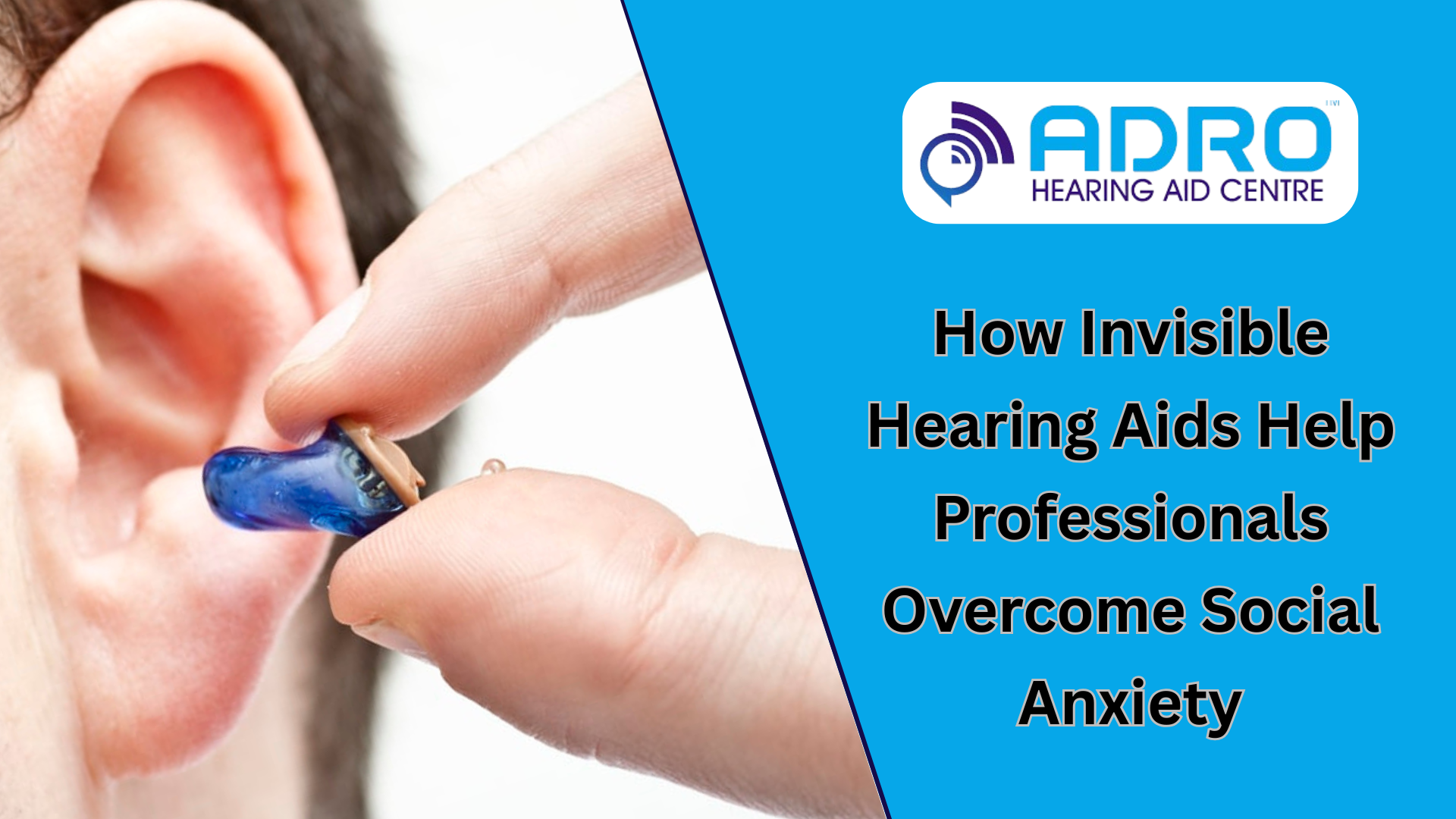

How Invisible Hearing Aids Help Professionals Overcome Social Anxiety
Success in a modern career is often found in the margins of conversation. It is the ability to catch a client’s hesitation or a subtle side-comment in a crowded boardroom. For many executives, hearing loss isn’t just about volume; it creates a persistent social anxiety. The fear of missing a cue or giving a mismatched answer causes a self-imposed withdrawal. We see professionals choose silence over the risk of appearing incompetent. While a Speech Therapist in Chennai can help polish a public speaker’s delivery, the core issue remains a lack of raw auditory data. If you can’t hear the room, you can’t lead it. Restoring that clarity is the first step toward regaining a commanding professional presence.
The Silent Burden of Professional Hearing Loss
Social anxiety in the workplace often stems from a lack of control. When you cannot reliably hear the environment around you, your brain works overtime to fill in the gaps. This cognitive load is exhausting. We see professionals who come to us reporting “brain fog” by 2:00 PM, which is often just the result of five hours of intense straining to hear colleagues in open-plan offices.
This specific type of anxiety manifests in subtle but damaging ways:
- The tendency to arrive late to meetings to avoid the “small talk” phase where background noise is highest.
- Intense sweating or heart palpitations when a colleague speaks from behind or from a different room.
- Hyper-focusing on lip-reading, which makes the professional appear intense or distracted rather than engaged.
- Avoiding networking events altogether, leading to missed partnership opportunities.
The anxiety is compounded by the perceived stigma of traditional hearing devices. Despite the prevalence of technology in our ears, from AirPods to Bluetooth headsets, there remains a lingering, outdated concern that a visible hearing aid signals a decline in capability or sharp-wittedness. This isn’t true, but the feeling is real. This is why the invisible hearing aid has become a transformative tool for the modern workforce. By removing the visual marker of the device, we allow the professional to focus entirely on the conversation rather than worrying about whether their companion is looking at their ear.
The Mechanics of Invisibility
When we discuss an invisible hearing aid, we are usually referring to Invisible-in-the-Canal (IIC) or Completely-in-the-Canal (CIC) models. These devices are custom-molded to fit deep within the ear canal, past the second bend. They use the mouth of the ear to collect sound, which helps with localisation, knowing exactly where a voice is coming from in a crowded room.
Technical specifications matter less than the outcome: these devices are truly undetectable to the observer. You can wear them during a presentation or a high-stakes negotiation without a single person realising you are receiving auditory assistance. This invisibility provides a psychological safety net. It allows a manager to walk into a room with the assurance that they will hear every question from the floor, without the self-consciousness that often accompanies larger, behind-the-ear models.
Rebuilding the “Communication Muscle”
Hearing is only half of the equation; processing and responding is the other. Long-term hearing loss often leads to “vocal hiding,” where a person speaks less because they aren’t sure of their own volume or clarity. In these cases, we often recommend speech therapy as a complementary approach to technology.
Hearing is only half of the equation; processing and responding is the other. Long-term hearing loss often leads to “vocal hiding,” where a person speaks less because they aren’t sure of their own volume or clarity. In these cases, we often recommend speech therapy as a complementary approach to technology.
It isn’t just about stutters. For an executive, it is about reclaiming the authority in their voice. When you stop hearing yourself clearly, you stop trusting your own volume. You might start mumbling to avoid a mistake or shouting to compensate for the silence.
Reintegrating into professional dialogue with speech therapy requires a specific focus:
- Physical Articulation: Sharp ‘s’ and ‘t’ sounds often fade from your speech when you aren’t hearing high frequencies. We work to bring that crispness back.
- Timing and Interjection: Learning to jump into a conversation at the right beat. If you are processing sound slowly, you are always a second late to the point.
- Environmental Projection: Adjusting your voice for the specific room, whether it’s a tight huddle in a glass-walled office or a large lecture hall.
When you combine the physical ability to hear through advanced technology with the vocal confidence gained through these targeted exercises, social anxiety begins to dissipate. You are no longer guessing. You are participating.
Navigating the Modern Office Environment
The shift toward glass-walled offices and hard-surfaced meeting rooms has created an acoustic nightmare. Echoes and background hums from HVAC systems can scramble speech for anyone, but for those with even mild hearing loss, it makes work impossible. The best hearing aids for professionals today aren’t just amplifiers; they are sophisticated processors.
They use artificial intelligence to distinguish between the person speaking directly in front of you and the clatter of the coffee machine thirty feet away. We have observed that professionals who switch to these high-end, discreet devices report an immediate drop in their heart rate during meetings. The “fight or flight” response triggered by the inability to understand one’s surroundings is replaced by a sense of calm.
Choosing the best hearing aids involves looking at how you work:
- Do you spend four hours a day on the phone?
- Do you move between quiet offices and noisy manufacturing floors?
- Are you frequently in “round table” environments where voices come from 360 degrees
The technology must be versatile enough to adapt to these shifts automatically. A professional shouldn’t have to fiddle with settings in the middle of a pitch. The tech should just work, silently and invisibly in the background.
Real-World Consequences of Avoidance
We have seen the trajectory of professionals who ignore their hearing loss. It usually starts with skipping the “optional” social hour. Then, they stop volunteering for committees. Eventually, they might even pass up a promotion because it involves more public speaking or travel. This is a high price to pay for a problem that has a technological solution.
The psychological relief of being able to hear a joke told at the end of a long table or catching a quick remark made by a CEO in an elevator, cannot be overstated. These “micro-interactions” are the glue of corporate culture. When you are cut off from them, you are cut off from the culture itself.
Strategy for Recovery
If you find yourself avoiding certain people or places because you are tired of asking them to repeat themselves, it is time for an assessment. This isn’t about “getting old”; it’s about optimising your performance. You wouldn’t try to work on a laptop with a broken screen, so why try to work with a compromised auditory system?
Social confidence returns through precision. We start with a technical fitting, then bridge the gap with consultations focused on your specific professional environment. This proactive shift prevents hearing clarity from becoming a career bottleneck.
At our Hearing Aid Centre In Chennai, we match technology to your daily workflow. For the professional, the device should be a utility, not a distraction. By choosing a discreet path, you rejoin the conversation with the certainty that you are hearing every detail.